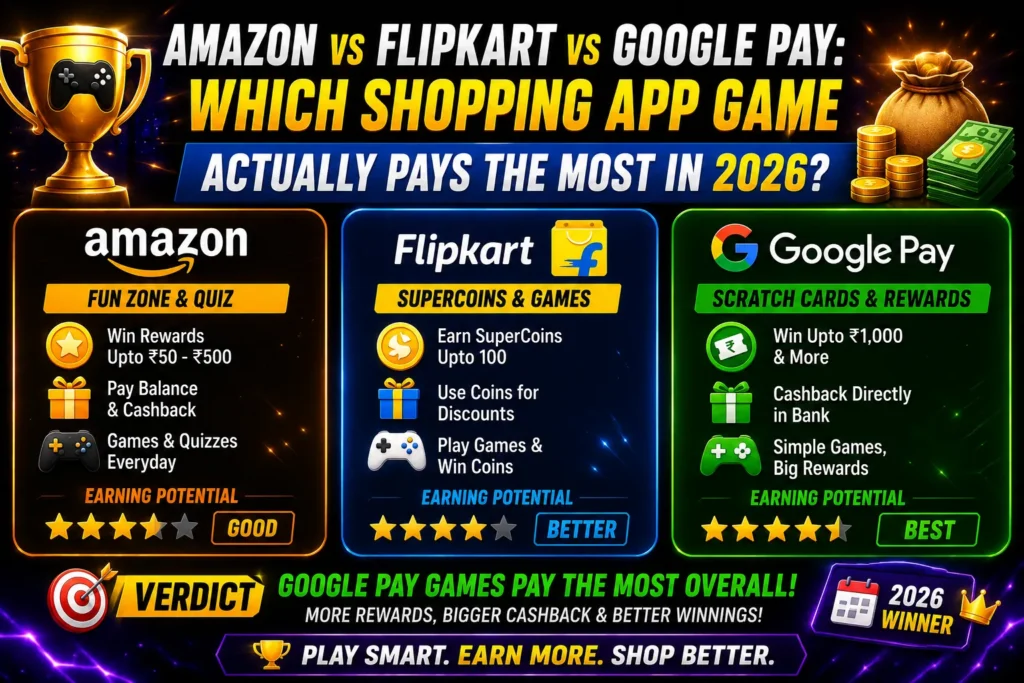
Amazon vs Flipkart vs Google Pay: Which Shopping App Game Actually Pays the Most in 2026?
Last updated: June 30, 2026
Amazon, Flipkart, and Google Pay all run some version of an in-app “game” that promises free cash, vouchers, or gadgets. But these three work on completely different mechanics, and that difference matters more than the headline prize amount. We broke down how each one actually pays out — not just what they advertise — so you can decide where your time is best spent.
The Quick Answer
| Amazon (Quiz / Spin & Win) | Flipkart (Spin & Win / Game Zone) | Google Pay (Scratch Cards / Refer & Earn) | |
|---|---|---|---|
| How you win | Answer 5 quiz questions correctly, then enter a lucky draw | Spin a wheel or answer questions during live campaigns | Automatic scratch card after every transaction |
| Is it luck-based? | Yes — correct answers only make you eligible, a draw picks the winner | Yes — wheel spin and lucky draw selection | Partially — reward amount is random, but you’re guaranteed to get a card |
| Typical payout | Mostly smaller prizes (₹50 Amazon Pay balance, accessories); big-ticket items go to very few lucky-draw winners | Vouchers, SuperCoins; flagship phones for ₹1 are extremely low-probability lucky draws | ₹5 to ₹300 most commonly; the ₹1,00,000 ceiling is a rare outlier, not a realistic expectation |
| How often can you play | Once daily for the main quiz | Varies by live campaign — not always running | Every single transaction generates a card |
| Effort required | Low (a few taps) | Low to medium | Zero — happens automatically when you pay |
| Reliability | You may go weeks without winning anything | Campaigns start and stop; some past formats (like Flipkart’s “Fake or Not”) have been discontinued entirely | Most consistent — something is credited far more often, even if it’s small |
Bottom line up front: if “pays the most” means guaranteed, repeatable small amounts, Google Pay wins on consistency. If it means chasing a jackpot, Amazon and Flipkart’s lucky draws technically offer higher ceiling prizes — but at odds low enough that most users never see them.
Amazon: Daily Quiz + Spin & Win
Amazon runs an app-only Daily Quiz (5 questions, 4 options each, running 12 AM to 11:59 PM) where correct answers enter you into a lucky draw — it doesn’t pay out automatically just for answering correctly. There’s also a separate Spin & Win format: a single-question contest where spinning a wheel determines your potential prize, which you then still have to claim and verify through a quiz step.
What you can realistically expect: small instant prizes are common in some campaigns (regional spin promotions have offered ₹50–₹150 tiers, for example), but headline prizes — phones, large Amazon Pay balances — are awarded to a small number of lucky-draw winners, not every correct participant. Amazon also runs special edition quizzes tied to sales events (like its Summer Sale) with puzzle-style contests offering bigger prizes, but again gated by a draw or “first to complete” mechanic rather than guaranteed payout.
Pros: Zero cost to enter, takes under a minute daily, genuinely free. Cons: Purely luck-based for anything beyond token prizes; most days end in no reward at all.
Flipkart: Spin & Win and Rotating Game Zone Campaigns
Flipkart’s gamified rewards live mostly in its app’s Game Zone, and unlike Amazon, the specific games rotate heavily. Its older video-quiz formats — “Fake or Not,” “Daam Sahi Hai,” and similar shows — were discontinued as a live, rewarded feature; if you see a blog promising current rewards for those, that’s outdated information. What’s currently active instead includes Spin & Win promotions (often tied to sale events) and campaigns like “Jyada Khelo Jyada Jeeto” during Big Billion Days, where users collect in-app “tickets” through repeat play to improve their odds in a prize draw — including occasional headline prizes like a flagship phone for ₹1.
What you can realistically expect: SuperCoins (Flipkart’s loyalty currency) are the most commonly distributed reward and can be redeemed against future orders. Genuinely large prizes — phones, big vouchers — are again lucky-draw outcomes with a large pool of participants, so the realistic expected value per spin is low even though the advertised prize is high.
Pros: SuperCoins have real, repeated utility on the platform even if you don’t win the headline prize. Cons: Campaign availability is inconsistent — you can’t count on a specific game being live when you check, and older “evergreen” formats have quietly ended.
Google Pay: Scratch Cards and Refer & Earn
Google Pay’s model is structurally different: instead of a quiz or spin, you get an automatic scratch card after eligible transactions (sending/receiving money, bill payments, recharges). According to Google’s own help documentation, the scratch card can be worth anywhere from a few rupees up to a stated maximum, with rewards typically settling into your linked bank account within about 7 business days. There’s also a Refer & Earn program: Google’s official terms state you can earn up to 100 referral rewards by inviting new users, credited once the invitee makes their first payment.
A commonly cited figure across deal-aggregator sites is around ₹201 per successful referral, though that exact amount isn’t published in Google’s own terms and can vary by campaign — confirm the current rate inside your app’s Rewards section before relying on it.
What you can realistically expect: most scratch cards land in the ₹5–₹300 range. The advertised maximum (up to ₹1,00,000 on some campaign terms) is real but extremely rare — treat it the same way you’d treat a lottery ceiling prize, not a typical outcome.
Pros: No separate “game” to remember to play — it’s tied to payments you’re already making, and something is credited far more consistently than with quiz/spin formats. Cons: Individual amounts are usually small; this isn’t a path to a “free iPhone,” just steady micro-cashback.
So Which One Actually Pays the Most?
It depends on what you’re optimizing for:
- Most consistent small wins: Google Pay — because the reward is tied to transactions you’re making anyway, not a competitive draw.
- Highest ceiling prize (if you get lucky): Flipkart’s Big Billion Days-style campaigns and Amazon’s special-edition quizzes, both of which occasionally offer flagship phones — but treat these as a lottery ticket, not a plan.
- Best effort-to-reward ratio for casual play: Amazon’s daily quiz, since it takes under a minute and has zero downside, even if most days yield nothing.
Realistically, none of these should be treated as an income source. They’re small, occasional perks layered on top of shopping and payments you’d likely be doing anyway — the consistent way to “win” is to use whichever platform you already shop or pay on most, rather than chasing whichever one has the flashiest prize this week.
Frequently Asked Questions
Which app gives the biggest single prize? Flipkart and Amazon both occasionally offer flagship smartphones through lucky-draw mechanics during major sale events, but these go to a tiny fraction of participants.
Is Google Pay’s scratch card guaranteed money? You’re guaranteed to receive a scratch card on eligible transactions, but the amount is randomized and most fall in the lower range rather than the advertised maximum.
Is Flipkart’s “Fake or Not” quiz still active in 2026? No — Flipkart discontinued its video-quiz section, including “Fake or Not,” as a live rewarded feature. Current gamified rewards are concentrated in Spin & Win and campaign-specific contests instead.
Do I need to spend money to participate in any of these? Amazon’s daily quiz and Flipkart’s Spin & Win are typically free to enter. Google Pay’s scratch cards are generated by transactions you make, so they’re tied to money movement rather than a pure entry fee.
Can I rely on these for regular income? No — all three are promotional engagement tools designed to increase app usage, not income programs. Treat any prize as a bonus on activity you were already doing.
Terms, prize pools, and active campaigns change frequently across all three platforms. Always confirm the current offer inside the official app before assuming a specific reward applies.

Rishabh Sabarwal




![[Live]How To Get Disco & Selfie Stamp Google Pay offer(New Trick)](https://www.freetricksworld.com/wp-content/uploads/2019/12/how-to-get-disco-selfie-stamp.jpg)