NRI Fixed Deposit Rates in India 2026: Banks, Tax & Comparison
Looking for the best NRI fixed deposit rates in India in 2026? If you live outside India and want to invest your savings in an Indian bank, fixed deposits can provide predictable interest payments and a defined maturity date.
However, choosing an NRI FD isn’t simply about finding the highest advertised interest rate. You also need to understand whether an NRE, NRO, or FCNR(B) deposit is suitable, how India taxes the interest, whether your money can be transferred abroad, and what happens when exchange rates change.
Interest rates have also changed during 2026, making older comparison tables unreliable.
In this guide, we compare NRI FD interest rates from SBI, HDFC Bank, ICICI Bank, and Axis Bank, explain the important differences between NRE, NRO, and FCNR(B) deposits, and show how to assess the overall return before opening an account.
Last researched: October 12, 2026.
Important: This article is for general financial education and does not constitute personalized investment, tax, or legal advice. Rates can change before a deposit is booked. Confirm the current rate and your eligibility with the bank, and consult a qualified cross-border tax adviser when appropriate.

Quick Answer: Which Bank Offers the Best NRI FD Rates in 2026?
For deposits below ₹3 crore, the official schedules reviewed on October 12, 2026 show a 6.25% annual NRE FD rate for the relevant one-year deposit band at SBI, HDFC Bank, ICICI Bank, and Axis Bank.
That doesn’t mean these banks pay the same rate for every maturity. Their rates can differ for longer tenures, deposit sizes, special products, and premature-withdrawal options.
The best choice depends on:
- The amount you want to deposit.
- Whether your funds come from India or overseas.
- The currency in which you want to save.
- How long you can leave the money invested.
- Your need to transfer the maturity proceeds abroad.
- Tax obligations in India and your country of residence.
- Your bank’s deposit insurance and withdrawal conditions.
If you plan to bring foreign earnings into India and are comfortable with rupee exposure, an eligible NRE fixed deposit may be suitable.
For income earned in India, an NRO fixed deposit is often relevant.
For foreign-currency savings that you want to maintain in a permitted currency, an FCNR(B) deposit may be worth comparing.

NRI Fixed Deposit Interest Rates in India — October 2026
The following comparison uses official bank schedules, rather than historical rates copied from older articles.
One-Year NRE FD Rate Comparison
| Bank | One-year NRE FD rate | Official reference |
|---|---|---|
| State Bank of India | 6.25% p.a. | Schedule effective August 15, 2026 |
| HDFC Bank | 6.25% p.a. | Schedule effective August 19, 2026 |
| ICICI Bank | 6.25% p.a. | Schedule effective October 9, 2026 |
| Axis Bank | 6.25% p.a. | Published NRE FD rate schedule reviewed October 12, 2026 |
Comparison assumptions: These examples refer to the relevant one-year NRE tenure band for deposits below ₹3 crore, with the standard available withdrawal structure. They are not live rate quotations or a ranking of every Indian bank.
Before opening an FD, check the exact day count, tenure band, deposit size, and bank’s currently applicable schedule.
Why a One-Year Comparison Is Useful
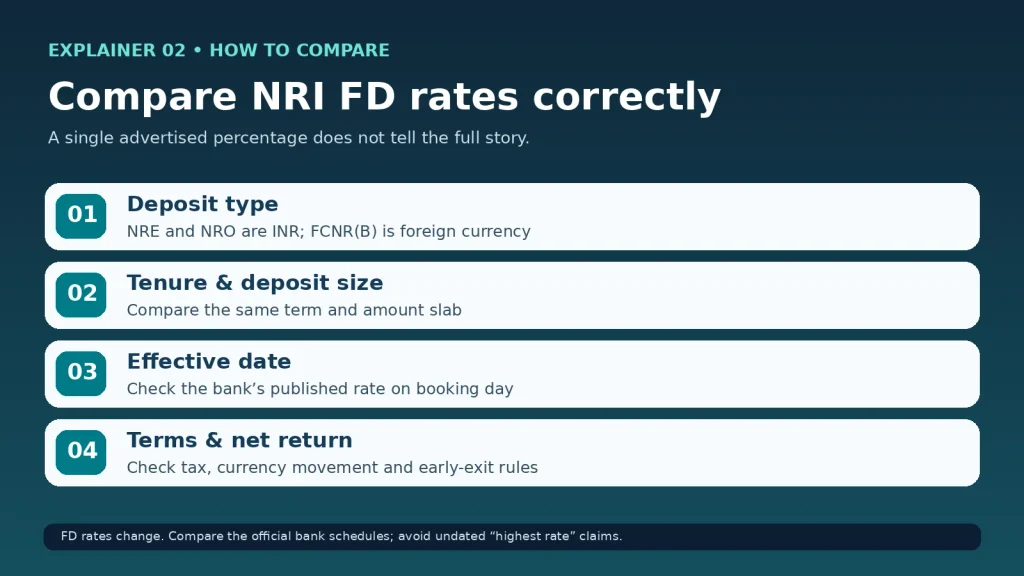
Some websites compare a bank’s highest rate for an 18-month promotional deposit against another bank’s ordinary five-year rate.
That doesn’t tell you which bank offers the best deal for the same investment period.
Instead, compare identical or closely matched maturities.
For example, if you want a one-year deposit, check the available one-year rate at each bank. If you can leave the funds for three years, compare the relevant three-year slabs separately.
Do not choose a bank simply because its website advertises a high maximum rate that applies only to a narrow special tenure.
SBI NRI Fixed Deposit Interest Rates
State Bank of India publishes a dedicated schedule for NRE fixed deposits.
According to its schedule effective August 15, 2026, the following rates apply to eligible NRE deposits below ₹3 crore:
| Tenure | NRE FD rate |
|---|---|
| 1 year to less than 2 years | 6.25% |
| 444-day Amrit Vrishti tenure | 6.45% |
| 2 years to less than 3 years | 6.40% |
| 3 years to less than 5 years | 6.30% |
| 5 years to 10 years | 6.05% |
These are rates for the specified deposit amount band, not every bulk-deposit category.
SBI publishes separate schedules for larger amounts.
What to Check at SBI
Before booking an NRE FD, compare the ordinary tenure rates with any available special-tenure product.
Also check the minimum holding period, early closure policy, interest-payment arrangement, and maturity instructions.
SBI states that no interest is payable on an NRE deposit that remains with the bank for less than one year.
Official source: https://sbi.bank.in/web/interest-rates/interest-rates/sbi-nri-services-interest-rates/sbi-nri-services-nre-fixed-deposit-interest-rate
HDFC Bank NRI Fixed Deposit Interest Rates
HDFC Bank publishes combined schedules covering domestic, NRO, and NRE term deposits.
For amounts below ₹3 crore, its schedule effective August 19, 2026 includes:
| Tenure | Applicable standard rate |
|---|---|
| 1 year to less than 15 months | 6.25% |
| 15 months to less than 18 months | 6.35% |
| 18 months to less than 21 months | 6.45% |
| 21 months to 2 years | 6.45% |
| 3 years 1 day to less than 4 years 7 months | 6.50% |
| 5 years 1 day to 10 years | 6.15% |
NRE deposits have a minimum tenure of one year.
The bank also clarifies that its advertised additional senior-citizen rates do not apply to NRI fixed deposits.
What to Check at HDFC Bank
Compare the standard rate with the actual product and amount you intend to book.
Review whether the FD permits premature withdrawal, whether it pays interest periodically or cumulatively, and whether your account can be managed through NRI NetBanking.
Official source: https://www.hdfc.bank.in/fixed-deposit/fd-interest-rate
ICICI Bank NRI Fixed Deposit Interest Rates
ICICI Bank has a dedicated NRI FD rate page that distinguishes deposit amount slabs and withdrawal options.
Its published schedule effective October 9, 2026 includes the following standard rates for the displayed deposit category below ₹3 crore:
| Tenure | Applicable standard rate |
|---|---|
| 1 year to 389 days | 6.25% |
| 390 days to less than 18 months | 6.25% |
| 18 months to 2 years | 6.30% |
| 2 years 1 day to 3 years | 6.45% |
| 3 years 1 day to 5 years | 6.50% |
| 5 years 1 day to 10 years | 6.50% |
The bank’s published page also includes separate non-withdrawable deposit rates. These should not be treated as interchangeable with ordinary withdrawable FDs.
What to Check at ICICI Bank
An NRI should confirm the selected deposit type before comparing interest.
ICICI Bank states that NRE interest is not subject to Indian TDS under applicable rules, while NRO interest is subject to tax deduction.
The bank also explains that closing an NRE FD before one year results in no interest payment.
Official source: https://www.icici.bank.in/nri-banking/deposits/fixed-deposit/fd-interest-rates
Axis Bank NRI Fixed Deposit Interest Rates
Axis Bank publishes NRE FD rates separately from ordinary domestic deposit information.
Its official rate summary reviewed for this article included:
| Tenure | NRE FD rate for deposits below ₹3 crore |
|---|---|
| 1 year to 1 year 10 days | 6.25% |
| 18 months to less than 2 years | 6.50% |
Rates for other tenures and larger deposits should be checked on the complete current schedule.
What to Check at Axis Bank
Axis Bank also offers products with different premature-withdrawal conditions.
A non-withdrawable fixed deposit may have terms that are materially different from a standard NRE FD.
Compare the ability to exit early before selecting a product based on its advertised rate.
Official source: https://www.axis.bank.in/interest-rates-and-charges
What About Yes Bank, IndusInd, Kotak, PNB, and Bank of Baroda?
These are among the other Indian banks that NRIs may consider.
However, there is no reliable basis for declaring Yes Bank or IndusInd Bank the highest-paying choice for October 2026 using the historical figures in our previous article.
For an accurate comparison, request or retrieve the official rate applicable to the same:
- Deposit amount.
- Currency.
- Tenure.
- NRE, NRO, or FCNR(B) product.
- Premature-withdrawal option.
- Date of deposit.
For FCNR(B), compare the same currency across banks. A USD deposit rate should not be compared directly with an INR NRE rate without accounting for currency differences.
The highest advertised percentage is not automatically the best overall option.
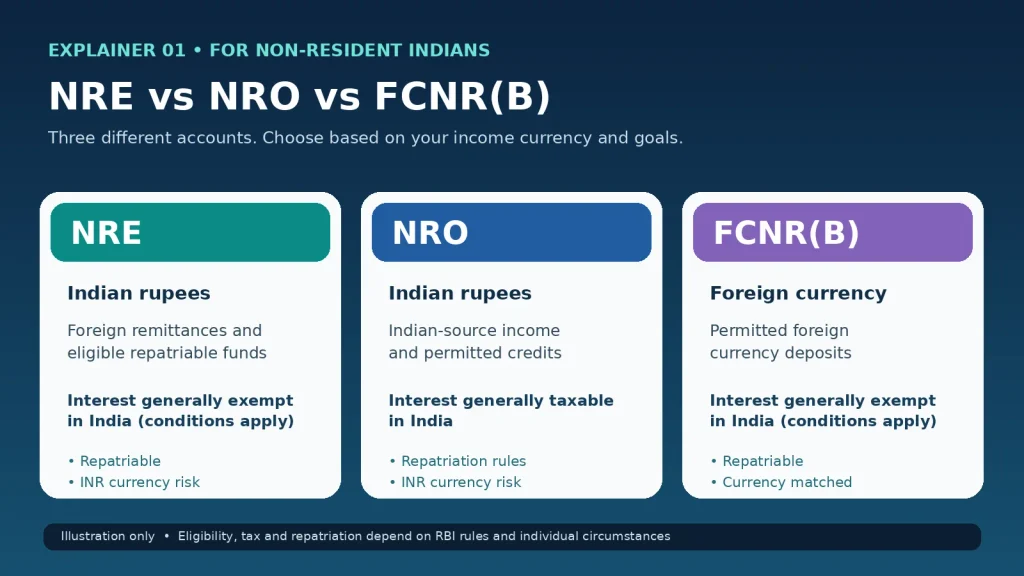
NRE vs NRO vs FCNR(B) Fixed Deposits: Key Differences
Choosing the correct account is more important than finding a marginally higher interest rate.
| Feature | NRE fixed deposit | NRO fixed deposit | FCNR(B) fixed deposit |
|---|---|---|---|
| Currency | Indian rupees | Indian rupees | Permitted foreign currency |
| Typical source of funds | Eligible overseas earnings and repatriable funds | Indian income and other permitted credits | Eligible overseas or repatriable foreign-currency funds |
| Interest tax in India | Generally exempt if conditions are met | Generally taxable | Generally exempt if conditions are met |
| Principal repatriation | Repatriable | Subject to applicable restrictions and conditions | Repatriable |
| Exchange-rate exposure | Yes, relative to foreign currency | Yes, relative to foreign currency | Depends on currency in which future funds are needed |
| Typical deposit tenure | Minimum 1 year | Bank product dependent | Generally 1–5 years |
What Is an NRE Fixed Deposit?
An NRE fixed deposit is an Indian-rupee deposit available to eligible non-residents.
Money remitted from abroad is generally converted into rupees before being placed in the deposit.
Its important advantages include eligibility for Indian income-tax exemption on interest and repatriation of principal and interest, subject to applicable rules.
The main consideration is currency risk.
If the rupee depreciates against the foreign currency you eventually need, a high rupee interest rate may not translate into a high return in that currency.
What Is an NRO Fixed Deposit?
An NRO fixed deposit is maintained in Indian rupees and is especially relevant when an NRI has legitimate income or balances in India.
Examples include rent, pensions, interest and other permitted Indian-source receipts.
Interest on NRO deposits is generally taxable in India.
Repatriating funds is subject to the relevant foreign-exchange and tax procedures.
What Is an FCNR(B) Fixed Deposit?
An FCNR(B) deposit holds funds in a permitted foreign currency, rather than converting them into Indian rupees.
Banks may offer deposits in currencies such as USD, GBP or EUR, depending on their products.
These deposits generally have tenures from one to five years, and interest may qualify for Indian income-tax exemption under the applicable rules.
An FCNR(B) deposit avoids direct INR conversion while the deposit is maintained in its chosen currency.
However, it is not completely free from currency risk. If you eventually need money in a different currency, exchange-rate movements can still affect the value of your proceeds.
For a deeper account comparison, read our NRE vs NRO vs FCNR Account Guide.
NRI Fixed Deposit Tax Rules in India
Tax treatment is one of the most important differences between the three deposit types.
Is NRE FD Interest Tax-Free?
Interest on an eligible NRE deposit is generally exempt from Indian income tax, provided the statutory conditions are met.
Banks ordinarily do not deduct Indian TDS from qualifying NRE interest.
However, an exemption in India does not automatically mean that the interest is exempt in your country of tax residence.
For example, an NRI living abroad may have local tax-reporting obligations that depend on the rules of that country.
Is NRO FD Interest Taxable?
Yes. Interest on NRO fixed deposits is generally taxable in India.
The standard non-resident withholding framework commonly involves TDS at 30% plus applicable surcharge and cess, subject to the relevant law and possible treaty relief.
The actual final tax liability can depend on the taxpayer’s circumstances, applicable rates, exemptions and the Double Taxation Avoidance Agreement (DTAA), if any.
Eligible treaty relief may require documentation such as a Tax Residency Certificate and other prescribed declarations.
Consult a qualified tax adviser rather than assuming the bank’s TDS is always equal to the final tax owed.
Is FCNR(B) Interest Tax-Free?
Interest on eligible FCNR(B) deposits generally qualifies for an Indian income-tax exemption subject to the relevant statutory conditions.
But the country where you reside may impose its own reporting or tax requirements.
Can NRIs Claim Double-Taxation Relief?
In certain situations, treaty provisions and foreign tax-credit arrangements may prevent or reduce double taxation.
The available relief depends on the specific treaty, tax residency, income classification and required documentation.
Tax benefits should never be assumed solely because an account is labeled NRE, NRO or FCNR.
Official references: Reserve Bank of India’s Non-Resident Account FAQs and the Income Tax Department’s guidance on non-resident taxation.
Can NRIs Repatriate Their FD Money Abroad?
Repatriation means transferring eligible funds outside India.
NRE Fixed Deposit Repatriation
Eligible NRE balances, including principal and interest, are generally repatriable under RBI rules.
Banks may still require appropriate processing and compliance checks.
FCNR(B) Repatriation
FCNR(B) deposits are also generally repatriable under the applicable rules.
The remittance currency and bank charges should be confirmed before closing or transferring the deposit.
NRO Fixed Deposit Repatriation
NRO balances have more restrictions.
The RBI permits eligible NRIs and PIOs to remit up to USD 1 million per financial year from qualifying NRO balances and other eligible assets, subject to applicable conditions and procedures.
Current income can have separate treatment under the rules.
The USD 1 million figure is a regulatory limit for eligible transactions, not an assurance that every account holder can transfer that amount without documentation.
Your bank may request proof of the source of funds, tax-compliance documentation and declarations. Form 15CA or a chartered accountant’s Form 15CB may be applicable depending on the remittance.
Confirm the specific requirements with the authorized dealer bank and your tax adviser.
How Safe Are NRI Fixed Deposits in India?
Bank fixed deposits can offer predictable contractual interest, but they are not risk-free.
A deposit may be exposed to bank failure, interest-rate changes upon renewal, inflation, liquidity restrictions and exchange-rate movements.
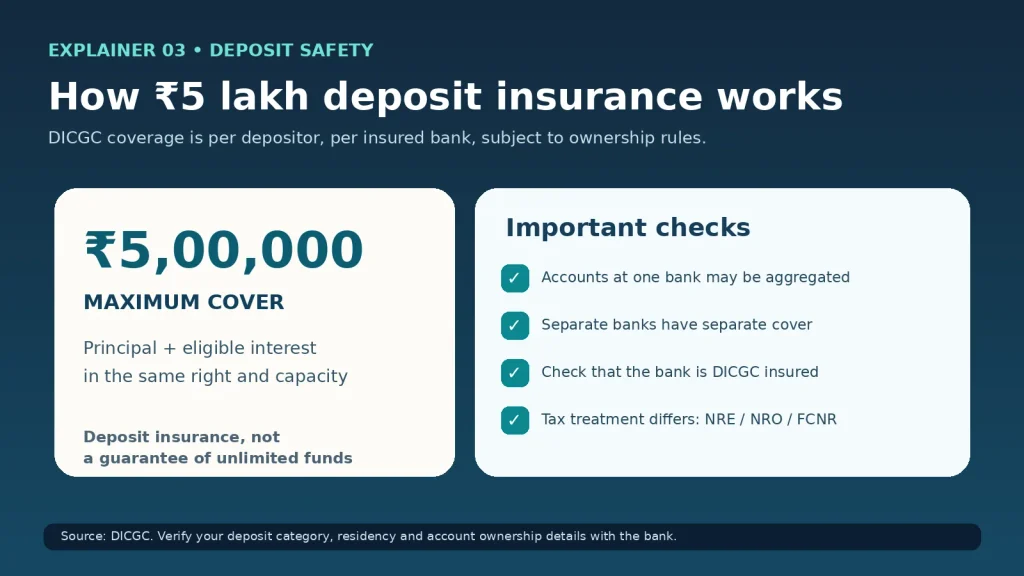
DICGC Insurance: ₹5 Lakh Limit
India’s Deposit Insurance and Credit Guarantee Corporation (DICGC) provides insurance for eligible deposits held with insured banks.
The maximum coverage is ₹5 lakh per depositor per insured bank, covering principal and eligible accrued interest together, subject to the same-right-and-capacity rules.
It is not ₹5 lakh per separate FD.
For example, if a person holds multiple eligible accounts in the same ownership capacity at one insured bank, their balances may be aggregated for insurance purposes.
Eligible deposits held at different insured banks can receive separate coverage.
Deposits placed with non-banking financial companies are not covered by DICGC’s bank deposit insurance scheme.
Always verify that the bank and particular deposit arrangement satisfy the applicable coverage rules.
Does a Higher Interest Rate Mean Higher Risk?
A higher deposit rate does not automatically establish that a bank is unsafe.
However, depositors should consider the bank’s regulatory status, financial strength, deposit insurance arrangements, and their own exposure to a single institution.
Avoid choosing a deposit solely because its interest rate is a few percentage points higher.
NRI FD Currency Risk: Why the Highest Rate May Not Win
A rupee-denominated FD may offer a higher stated interest rate than an FCNR(B) deposit in USD or another foreign currency.
But the two returns are not directly comparable.
Imagine an NRI places money in a rupee deposit and later converts the maturity proceeds back into US dollars.
If the rupee depreciates during the investment period, the dollar value of the maturity proceeds may be lower than expected.
If the rupee appreciates, the opposite may occur.
Exchange spreads and transfer fees can also affect the amount received.
This is why the best deposit depends partly on the currency in which you plan to use the money.
If you need rupees for expenses in India, a rupee deposit may be more appropriate.
If you are saving for expenses in USD, GBP or another supported currency, compare foreign-currency deposit alternatives carefully.
NRI Fixed Deposit Returns: A Simple Example
Suppose an eligible NRI invests ₹1,00,000 in a one-year FD at a nominal annual rate of 6.25%.
Using a simple-interest illustration:
Interest = Principal × Annual rate × Time
₹1,00,000 × 6.25% × 1 year = ₹6,250
This gives an illustrative value of ₹1,06,250 before any applicable tax, charges or other adjustments.
The actual maturity amount may differ depending on the bank’s interest calculation, compounding schedule and deposit terms.
For NRO deposits, also consider applicable Indian taxation and withholding.
For NRE deposits, consider the eligible tax exemption and currency conversion if the funds will be transferred overseas.
How to Compare Net Returns
Before investing, consider the following:
- The quoted annual interest rate.
- Interest compounding or payout frequency.
- Tax treatment of that particular deposit.
- Any exchange-rate conversion.
- Bank charges and remittance costs.
- Early-withdrawal conditions.
- Whether the maturity value will meet your financial objective.
How to Open an NRI Fixed Deposit Account
The account-opening process varies across banks and your existing customer status.
Step 1: Confirm Your Non-Resident Eligibility
NRE and FCNR(B) accounts have specific eligibility requirements, while NRO accounts are available under the relevant FEMA rules.
Check that you qualify for the product.
Step 2: Choose the Correct Account
Decide whether NRE, NRO or FCNR(B) matches your source of funds and intended use.
Avoid depositing money through a channel that is not permitted for the chosen account.
Step 3: Compare Current Bank Rates
Review the official rate card and its effective date.
Ask the bank to confirm the exact maturity amount for your chosen principal and tenure.
Step 4: Prepare KYC Documentation
Depending on the bank and jurisdiction, documentation may include:
- Passport.
- Visa, residence permit or overseas residency proof.
- Overseas address verification.
- PAN or other permitted tax documentation.
- Photograph and identity information.
- FATCA or CRS declarations.
- Source-of-funds evidence where required.
The exact requirements can differ between banks.
Step 5: Complete the Bank’s Account-Opening Process
Existing NRI banking customers may be able to book an FD through an approved online or mobile-banking channel.
New customers may need additional verification, documentation or assistance from a bank representative.
Do not assume every NRI can complete all steps online in every country.
Step 6: Transfer Eligible Funds
Fund the account through an approved banking channel.
The permitted source of funds will depend on the account type and applicable regulations.
Step 7: Review the Deposit Confirmation
Before relying on the FD, confirm the interest rate, amount, tenure, payout method, maturity date, nomination and renewal instructions.
Keep the confirmation in a secure location.
NRI FD Premature Withdrawal Rules
Early withdrawal can significantly reduce the return on a fixed deposit.
For NRE FDs, banks commonly provide no interest if the deposit is closed before completing the minimum one-year period.
For an eligible deposit held longer than the minimum, the bank may calculate interest according to the actual period and apply a prescribed penalty.
Terms vary between banks and products.
Some large or specially structured deposits may not offer ordinary premature withdrawal at all.
Before opening an FD, ask:
- Can I close it early?
- How is interest recalculated?
- Is a penalty deducted?
- Are partial withdrawals allowed?
- Does taking a loan against the FD affect withdrawal rights?
- What happens on renewal?
These questions are particularly important if you may need the money unexpectedly.
Are Senior Citizen NRI FD Rates Higher?
Some Indian banks advertise additional FD interest for resident senior citizens.
However, do not automatically assume those premiums apply to NRE or NRO deposits.
HDFC Bank and ICICI Bank explicitly state in their published NRI deposit information that the usual senior-citizen premium does not apply to NRI FDs.
Check the specific eligibility criteria at your chosen bank rather than relying on a general senior-citizen FD comparison.
Best NRI Fixed Deposit Strategy in 2026
There is no one strategy that is best for every NRI.
However, the following principles may help when comparing deposits.
Match the Tenure to Your Cash Needs
Avoid placing money needed in six months into an NRE FD with a minimum one-year holding period.
Select a tenure that matches when you will need the funds.
Compare Banks on Equivalent Terms
Use comparable maturities, deposit amounts and withdrawal options.
Do not mistake the highest advertised rate for the highest guaranteed net return.
Consider Deposit Insurance Limits
If you hold a large amount of cash, understand the DICGC insurance limit and the implications of keeping deposits at one or several banks.
Evaluate Currency Exposure
Choose between INR and foreign-currency deposits based partly on the currency in which you eventually expect to spend the money.
Review Tax Consequences in Both Countries
Indian exemption does not necessarily eliminate foreign tax obligations.
Consider professional cross-border tax guidance when substantial amounts are involved.
Keep a Record of FD Maturity Dates
A simple schedule of maturity dates can help you plan renewal, cash needs and currency conversion.
Some investors use staggered deposits, commonly called an FD ladder, to reduce the need to renew their entire deposit portfolio at once.
Frequently Asked Questions About NRI Fixed Deposits
1. Which bank offers the highest NRI FD interest rate in October 2026?
There isn’t one verified highest-paying bank for every amount, tenure and account type. The four official one-year NRE schedules compared in this article each show 6.25% for the relevant amount band.
2. Is NRE FD interest tax-free in India?
Eligible NRE interest is generally exempt from Indian income tax, subject to statutory conditions. Foreign-country taxation may still apply.
3. Is NRO fixed deposit interest taxable?
Yes. NRO interest is generally taxable in India and ordinarily subject to non-resident TDS rules, with possible treaty relief where applicable.
4. What is the difference between NRE and NRO FDs?
NRE deposits generally hold eligible repatriable rupee funds, while NRO deposits are commonly used for Indian-source income and have different tax and repatriation rules.
5. What is an FCNR(B) fixed deposit?
It is a bank fixed deposit denominated in a permitted foreign currency, available to eligible non-residents under RBI rules.
6. Which is better: NRE or FCNR(B)?
That depends on your intended currency, maturity needs, rates, tax circumstances and foreign-exchange exposure.
7. Can an NRI open a five-year fixed deposit?
Yes, eligible banks offer suitable multi-year NRE, NRO and FCNR(B) products, subject to the relevant tenure and eligibility rules.
8. What is the minimum tenure for an NRE FD?
The standard minimum NRE fixed deposit tenure is one year.
9. Can an NRI open an FD online?
Some banks allow eligible existing NRI customers to book deposits online. New customers may have additional KYC and onboarding requirements.
10. Can NRIs get the extra senior-citizen FD rate?
Do not assume so. Several major banks state that their ordinary senior-citizen premium does not apply to NRI fixed deposits.
11. How much NRI FD money is insured?
DICGC covers eligible deposits up to ₹5 lakh per depositor per insured bank, including eligible principal and accrued interest, subject to ownership rules.
12. Can I send NRE FD maturity proceeds abroad?
Eligible NRE funds are generally repatriable, subject to the applicable regulatory and banking requirements.
13. Can I transfer NRO FD proceeds abroad?
Eligible remittances are possible under applicable rules, including the USD 1 million per financial year facility for qualifying assets and balances, subject to conditions.
14. Will I lose interest if I close an NRE FD early?
If an NRE FD is closed before completing the one-year minimum period, banks commonly pay no interest. Later withdrawals may also involve lower applicable rates or penalties.
15. Are NRI FD rates fixed for the entire tenure?
For an ordinary fixed-rate FD, the contracted rate generally applies for the agreed tenure, subject to its terms. Future renewals use the rates applicable at that time.
16. Does a higher NRE interest rate mean a higher foreign-currency return?
Not necessarily. Exchange-rate changes and conversion costs affect the return when the rupee proceeds are converted abroad.
17. Can I hold both NRE and NRO fixed deposits?
Eligible NRIs may hold both under applicable rules when they have suitable sources of funds and banking needs.
18. What happens when an NRI permanently returns to India?
Account status and tax treatment may need to change. Inform your bank of your new residential status and obtain appropriate advice about redesignation or conversion.
Conclusion: How to Choose an NRI Fixed Deposit in 2026
When comparing NRI fixed deposit interest rates in India, look beyond the headline percentage.
SBI, HDFC Bank, ICICI Bank and Axis Bank all offered 6.25% on the relevant one-year NRE deposit bands in the official schedules reviewed for this article.
Longer tenures, special products and different deposit sizes can produce different rates.
More importantly, NRE, NRO and FCNR(B) deposits have different currency, taxation, repatriation and withdrawal characteristics.
An NRE FD may suit eligible overseas savings that you want to maintain in rupees. An NRO FD may be relevant for Indian-source income. An FCNR(B) FD may suit certain foreign-currency savings goals.
Before booking a deposit, confirm the bank’s latest rate, minimum tenure, early-withdrawal rules, tax implications and deposit insurance arrangements.
The best NRI FD is not necessarily the one offering the highest nominal interest. It is the one whose currency, liquidity, tax treatment, security and maturity align with your needs.
Related FreeTricksWorld Guides
- NRE vs NRO vs FCNR Account: Which One Should NRIs Choose?
- EPF vs PPF: Which Is Better for Retirement Savings? — verify URL before publication.
Official References
- RBI — Accounts in India by Non-Residents
- SBI — NRE Fixed Deposit Interest Rates
- HDFC Bank — Fixed Deposit Interest Rates
- ICICI Bank — NRI Fixed Deposit Interest Rates
- Axis Bank — Interest Rates and Charges
- DICGC — Deposit Insurance Guide
- Income Tax Department — Taxation of Non-Residents
Editorial disclosure: Researched October 12, 2026 using publicly available official rate schedules and regulator information. The examples are not guaranteed quotations or a comparison of the entire Indian banking market. No deposit was booked or bank-specific personalized advice obtained. Rates, laws and account eligibility should be verified before acting.

Dinesh Dandpat