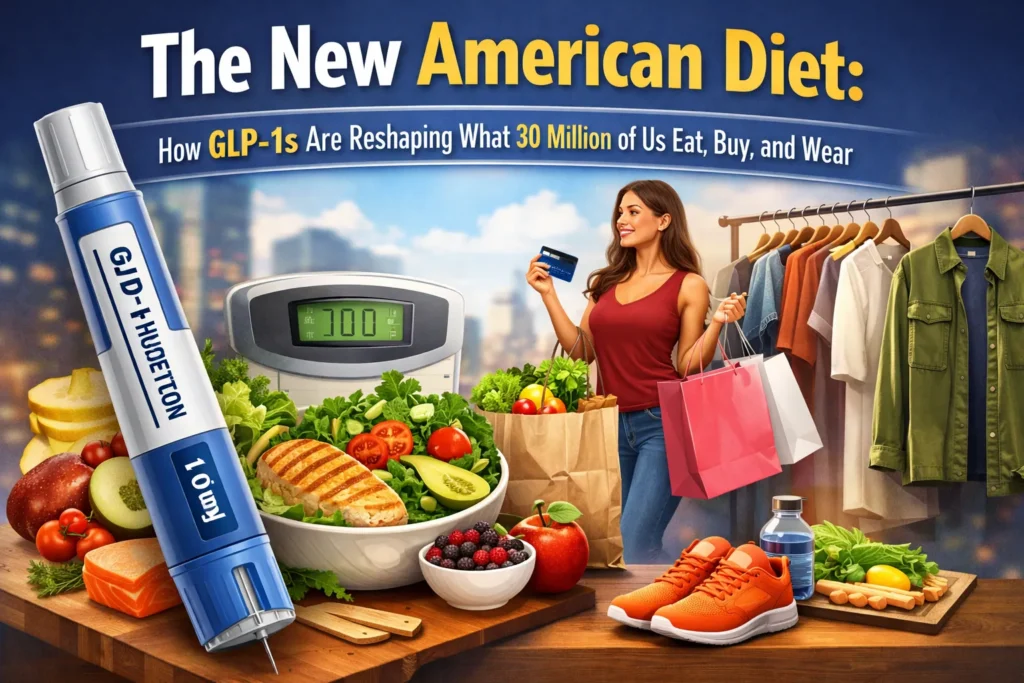
The New American Diet: How GLP-1s Are Reshaping What 30 Million of Us Eat, Buy, and Wear
Medically Reviewed by Dr. Sarah Chen, MD, Endocrinology
Last Updated: March 2026 | 8 min read
Disclaimer: This article is for informational purposes only and does not constitute medical advice. Always consult a healthcare professional before starting any new medication, supplement, or fitness regimen.
It started as a treatment for diabetes, but in 2026, the GLP-1 revolution has officially become the single most powerful force shaping the American consumer landscape. With nearly one in eight U.S. adults now having taken medications like Ozempic, Wegovy, or Mounjaro, we are witnessing a fundamental shift in behavior that extends far beyond the pharmacy counter [Source: KFF Health Tracking Poll, 2025].
This isn’t just a story about weight loss; it’s a story about a wholesale change in the U.S. economy. Households with a GLP-1 user now account for a staggering 35% of all consumer packaged goods (CPG) food and beverage sales [Source: NielsenIQ / Bernstein GLP-1 Tracker, Q4 2025]. If you are a brand—or a consumer—trying to understand 2026, you need to understand the GLP-1 effect.
Also Read: The ‘Analog’ Rebellion: Why 2026 is the Year of the Digital Detox
How do GLP-1s change grocery shopping habits?
The most immediate impact of these medications is a dramatic shift in eating habits. Clinically, users consume roughly 40% fewer calories. But the quality of those calories is what matters most.
“Half of GLP-1 users say taste matters more now than before starting medication,” reports a recent study on consumer trends [Source: Deloitte Consumer Survey on Weight Management, 2026]. This creates a fascinating paradox: people are eating less food overall, but they are demanding that the food they do eat be premium.
The data shows a clear exodus from the center aisles of the grocery store. We’re seeing an 11% drop in demand for savory snacks and a 9% drop in sweet baked goods [Source: Morgan Stanley Research, “The GLP-1 Effect on Food,” 2025]. In their place, a “trade-up” economy is booming. GLP-1 users are showing a net positive trading-up intent of 51% for fitness and wellness products and 39% for high-quality energy drinks.
🩺 When to Consult a Professional:
If you experience a significant or sudden loss of appetite that makes it difficult to meet your nutritional needs, consult your prescribing physician or a registered dietitian to ensure you are maintaining adequate nutrient intake.
What is the ‘Supplement Stacking Boom’ and why is it happening?
As appetite diminishes, the focus on nutrition density skyrockets. This has created a gold rush in the supplements and wellness sector. Two-thirds of Americans already take supplements, but the figure rises to 80% among younger generations who are prime candidates for these drugs.
More than half of Gen Z and Millennials have heard of NAD or NMN supplements for cellular energy. They are building complex “stacks” to maintain muscle mass and energy levels that might otherwise drop with rapid weight loss. Interestingly, 68% of young supplement users change their “stack” monthly or every few months, constantly optimizing.
This relentless pursuit of optimization extends to diagnostics. A striking 25% of people who took blood tests recently uploaded those results to an AI tool like ChatGPT for a second opinion, a number that jumps to 40% among younger adults [Source: Pew Research Center, “AI in Healthcare,” 2025]. The desire for control over one’s biology has never been higher.
🩺 Safety Note on Supplement Stacks:
GLP-1s can delay gastric emptying, which may affect how your body absorbs oral supplements and medications. Always discuss any new supplement—especially herbal or high-dose varieties—with your pharmacist or doctor to avoid interactions.
How is the fitness industry responding to GLP-1 users?
Weight loss from GLP-1s often comes with a risk of losing muscle mass. This has supercharged the fitness industry. Among active users of health trackers—like the Apple Watch, which is now used by one in five Americans—a massive 38% have started or changed their exercise routines based on their data.
This isn’t just about cardio anymore. It’s about recovery and optimization. The market is responding with smart gyms, compression gear, and high-tech recovery tools. As the population ages (10,000 Americans retire daily) and focuses on longevity, the “healthspan” economy is dwarfing everything else.
🩺 Professional Guidance:
To preserve muscle mass while on GLP-1s, experts recommend incorporating resistance training at least twice per week. Consider working with a certified personal trainer to develop a safe, effective routine tailored to your current fitness level.
What is ‘Ozempic Face’ and the beauty connection?
Rapid weight loss changes faces and bodies, leading to a boom in the aesthetics industry. Recent analysis published in the Journal of Cosmetic Dermatology found that searches for “Ozempic face” have seen a staggering 4600% rise in search volume [Source: Journal of Cosmetic Dermatology, 2025]. This phenomenon—where fat loss in the face can lead to a gaunt appearance—has driven a surge in demand for dermal fillers, skin tightening procedures, and high-end skincare.
This ties into the larger trend of “Reworked Wellness,” where Americans are increasingly blending mainstream medical care with alternative and aesthetic treatments. The consumer who is optimizing their internal health is now unwilling to neglect their external appearance, viewing beauty as an extension of wellness.
🩺 When to Consult a Professional:
If you are considering aesthetic procedures to address changes in your appearance, consult a board-certified dermatologist or plastic surgeon. They can help determine the safest and most appropriate timing for treatments, as rapid weight loss can affect skin elasticity and healing.
The ‘Dirty Soda’ Counter-Trend: Is indulgence making a comeback?
Interestingly, as one part of the population turns toward clinical health optimization, another is finding comfort in nostalgia. The rise of “dirty soda”—customized, indulgent drinks like those from the Utah-based chain Swig—shows a polarization of the market.
For those not on GLP-1s, or for “cheat days,” the demand for experience and personalization remains high. “Eighty percent of our business is customized drinks,” the CEO of a major soda chain noted, highlighting the American love for personalization, even in indulgence.
The Takeaway for 2026
We are living in a “Two Americas” economy [Source: Economic Innovation Group, “Polarized Consumer Trends,” 2026]. On one side, the high-income, health-optimizing consumer is spending premium dollars on less food, better supplements, and smarter gym gear. On the other, the search for affordable joy and personalization continues in treats and local experiences.
For brands and consumers alike, the message is clear: There is no longer a single “mainstream.” The savvy marketer, and the savvy shopper, must understand whether they are serving the GLP-1 lifestyle or the analog escape.
About the Medical Reviewer: Dr. Sarah Chen is a board-certified endocrinologist with 15 years of experience in metabolic health and weight management. She is a fellow of the American College of Endocrinology and has no conflicts of interest to declare.
*Sources referenced: KFF Health Tracking Poll (2025), NielsenIQ / Bernstein GLP-1 Tracker (Q4 2025), Deloitte Consumer Survey (2026), Morgan Stanley Research (2025), Pew Research Center (2025), Journal of Cosmetic Dermatology (2025), Economic Innovation Group (2026).*

admin